
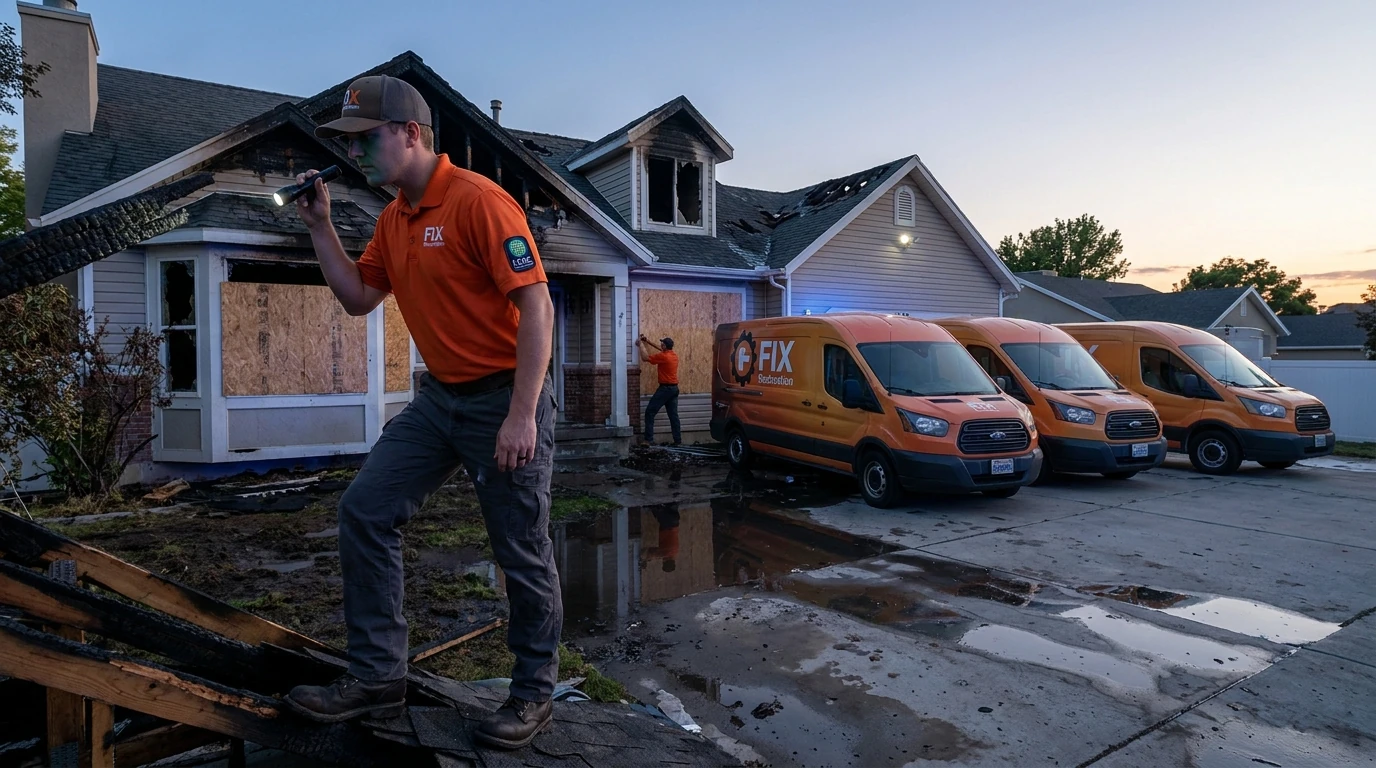
A house fire leaves behind more than charred walls. Even after the flames are out, smoke residue is still moving through your home, settling into insulation, soaking into drywall paper, and bonding to every porous surface it touches. The restoration process that follows is methodical and sequenced for a reason: skip a step or rush a phase, and you can end up with odor that returns months later, hidden corrosion on copper pipes and electrical contacts, or contents that looked salvageable but weren’t. Here is what actually happens, from the moment the fire department clears the scene to the day you move back in.
Step 1: Safety Assessment and Securing the Structure
Before anyone enters the home to begin work, the structure has to be evaluated. Fire compromises load-bearing elements in ways that aren’t always visible, a roof truss can look intact and still be dangerously weakened. A restoration crew will walk the perimeter and interior looking for collapse risk, compromised electrical panels, broken gas lines, and standing water from suppression hoses.
Utility shutoffs come next. In Utah County, that typically means coordinating with Rocky Mountain Power and Dominion Energy to confirm the service is isolated before any equipment goes inside. If windows or sections of the roof are open to the weather, the structure gets boarded and tarped, not just to protect your belongings, but because a second water intrusion event on top of fire damage dramatically complicates the claim and the drying timeline.
This phase also produces the documentation your insurance adjuster needs: photos of every affected room, moisture readings, air quality notes, and a preliminary scope of loss. Do not skip or rush this step. The thoroughness of early documentation directly affects how smoothly the claim moves.
Step 2: Water Removal and Drying
This surprises most homeowners: water damage is often the first thing addressed after a fire, not the last. Suppression water from hoses and sprinkler systems can leave several inches of standing water in lower levels, and that water begins promoting mold growth within 24 to 48 hours, the same window it would in any other water loss.
Extraction equipment pulls standing water from floors and cavities. Industrial air movers and dehumidifiers then run continuously, often for several days, to bring structural materials down to acceptable moisture levels before any cleaning or rebuilding begins. If a crew skips this phase and goes straight to smoke cleanup, they are sealing wet materials behind new finishes. That moisture has nowhere to go, and you will be dealing with mold remediation on top of everything else within a few months.
Moisture readings are logged daily. The drying phase is not complete until the numbers reach target levels, not until a set number of days have passed.
Step 3: Smoke and Soot Removal
This is the most labor-intensive phase and the one most people picture when they think about fire restoration. It is also the phase where cutting corners causes the most long-term problems.
Soot is not uniform. A fast-burning fire fed by synthetic materials (furniture foam, carpet, plastics) produces a different residue than a slow smoldering fire in a room full of wood and paper. Wet smoke residue, from a low-heat, oxygen-starved fire, is sticky, dense, and penetrates deeply into porous surfaces. Dry smoke from a fast, high-heat fire is powdery and easier to wipe but spreads further. Protein residue from a kitchen fire is nearly invisible on surfaces but produces an intense, persistent odor. Each type requires different cleaning chemistry and technique.
Hard surfaces, studs, joists, concrete block, get cleaned and treated. Drywall that has absorbed smoke beyond the surface layer is typically removed rather than cleaned, because no amount of wiping will neutralize odor locked inside the gypsum core. HVAC ducts are cleaned and in some cases replaced, because the system will redistribute smoke particles through the entire home every time it runs if the ductwork is left contaminated.
Contents, furniture, clothing, documents, electronics, are inventoried and either cleaned on-site or packed out to a controlled facility where they can be processed properly. This is also when the decision gets made about what is restorable and what needs to be documented as a total loss for your claim.
Step 4: Odor Neutralization
Removing visible soot does not remove odor. Smoke molecules are small enough to penetrate into concrete, into the adhesive layer under flooring, into wall cavities, and into wood framing. A home can look completely clean and still smell like smoke the moment the heat kicks on.
Odor neutralization typically involves a combination of approaches: thermal fogging, which uses a heated solvent to replicate the way smoke traveled and reach the same surfaces; hydroxyl generators or ozone treatments in unoccupied spaces, which chemically break down odor-causing compounds; and sealers applied to framing and subfloor surfaces that can’t be replaced. The right combination depends on the type of fire, the construction of the home, and what materials remain.
This phase cannot be shortcut with air freshener or paint. Painting over smoke-affected framing without sealing it first will result in odor bleeding back through the new finish within weeks.
Step 5: Reconstruction
Once the structure is dry, clean, and odor-free, rebuilding begins. This phase looks like any other renovation, drywall, insulation, flooring, cabinetry, paint, but it happens in a specific sequence tied to inspections and code compliance. In American Fork and throughout Utah County, permits are required for structural repairs, electrical work, and in some cases plumbing, depending on what was affected.
Restoration contractors who handle both the mitigation (cleanup) and the reconstruction phase can simplify this considerably. You are dealing with one point of contact, one scope document, and one set of insurance negotiations rather than coordinating between a cleanup crew and a separate general contractor.
The timeline for reconstruction varies widely based on the extent of damage. A contained kitchen fire with limited smoke spread might be a matter of weeks. A fire that traveled into the attic and compromised the roof structure can take several months. Your adjuster and your restoration contractor should be aligned on scope and timeline before reconstruction begins, changes mid-project are the most common source of delays and disputes.
If you are in the middle of this process, or just got the call that there has been a fire, the most useful thing you can do right now is document everything you can safely access and call a restoration professional before you start cleaning anything yourself. Wiping soot, airing out rooms, or running your HVAC can spread contamination and complicate both the cleanup and the claim. FIX Restoration handles fire and smoke damage in American Fork and the surrounding area, reach them at (801) 930-9750.