
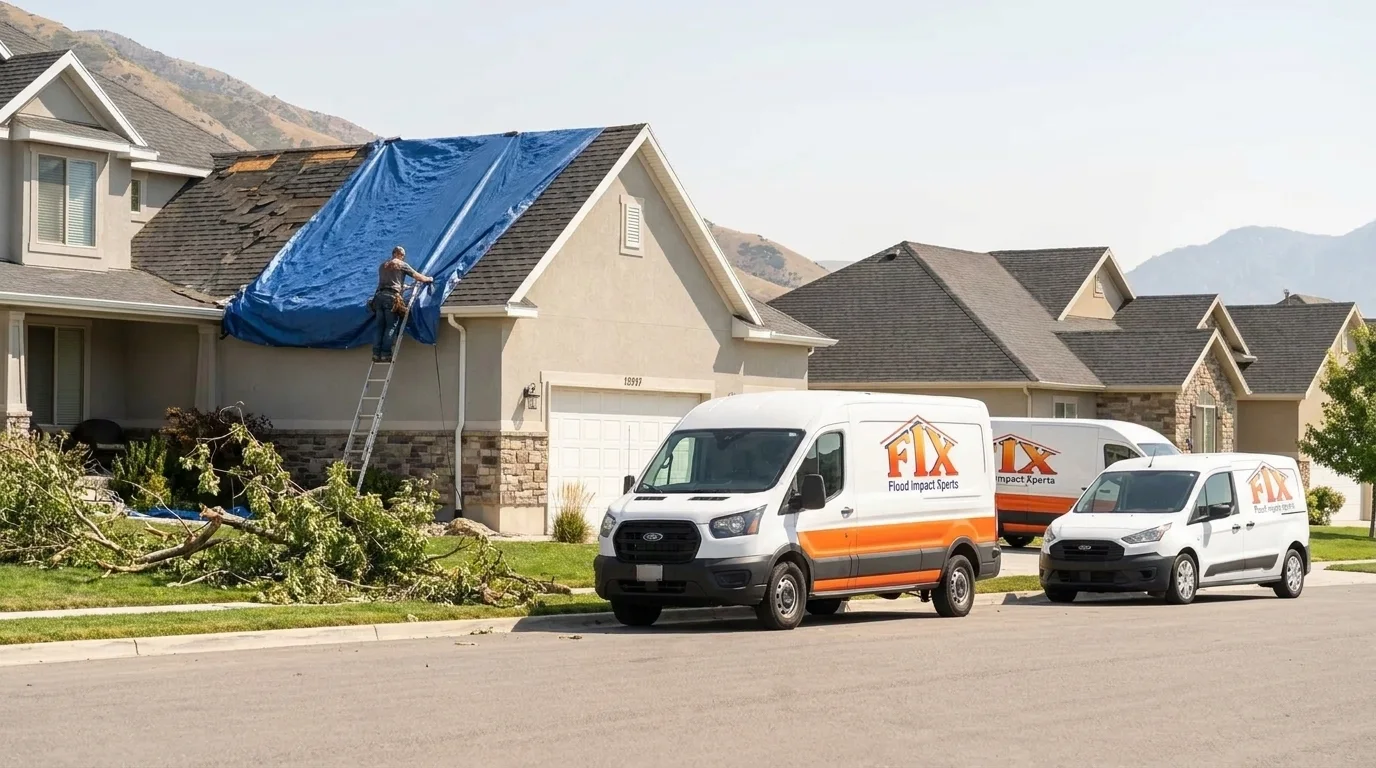
Emergency Storm Damage Restoration in American Fork
Emergency storm damage restoration in American Fork and surrounding areas. Insurance billing accepted. Call (801) 930-9750.
Storm damage emergency in American Fork? Call now for emergency service. Our crew responds fast to secure the property and stop further damage.
A storm can leave a roof open to the sky, a tree pinning a wall, and standing water spreading across hardwood floors, all at the same time. What makes storm damage uniquely complicated isn’t any single problem; it’s the layered sequence of them. Wind lifts shingles, rain follows through the gap, and within 24 to 48 hours, the moisture that soaked into framing and insulation is already creating conditions for mold. Getting the sequence of repairs right, and documented correctly for your insurance carrier, is what storm damage restoration actually demands.
What Storm Damage Restoration actually involves
Storm damage restoration spans three overlapping phases: emergency stabilization, water and debris mitigation, and structural repair. Each phase has its own equipment and timeline, and skipping ahead costs money.
Emergency stabilization means stopping additional loss. That’s tarping a compromised roof before the next rain cell arrives, boarding windows where glass failed, and securing any structural elements that are unstable. This work happens in hours, not days, because Utah County weather doesn’t pause while you wait for a contractor.
Mitigation follows immediately: extracting standing water with truck-mounted or portable extraction units, removing saturated insulation and drywall that cannot be dried in place, and setting commercial desiccant or refrigerant dehumidifiers alongside high-velocity air movers. Moisture readings are logged daily with calibrated meters, both pin-type for surface readings and non-invasive sensors for what’s hiding behind plaster or under subflooring.
Structural repair, framing, sheathing, roofing, siding, drywall, and finish work, begins only after affected materials reach documented dry standard. Rebuilding over wet framing is one of the most common and expensive mistakes in storm recovery.
Our process
-
Emergency stabilization and site safety, Before any assessment happens, the site has to be safe to enter and protected from further weather exposure. Roof tarps, temporary boarding, and debris hazard evaluation come first. If a tree is still loading a structure, that gets addressed before crews work inside.
-
Damage documentation and scope development, Every affected surface is photographed, moisture-mapped, and logged. This isn’t just for the insurance file, it’s the foundation of an accurate repair scope. We note the difference between wind-driven rain intrusion (which soaks wall cavities from the top down) and roof-deck failure (which saturates insulation and ceiling assemblies), because the drying strategy differs.
-
Water extraction and structural drying, Extraction removes bulk water; drying removes what’s left in materials. We place equipment based on psychrometric readings, temperature, relative humidity, and dew point, not by room count. Monitoring continues until affected assemblies reach dry standard, typically documented over three to five days depending on material depth and ambient conditions.
-
Debris removal and selective demolition, Storm debris, damaged roofing materials, compromised insulation, and unsalvageable drywall are removed and disposed of properly. Selective demolition, cutting out only what can’t be dried or repaired, keeps the rebuild scope and cost as tight as possible.
-
Reconstruction and final inspection, Framing, sheathing, roofing, insulation, drywall, and finishes are restored to pre-loss condition. Work is scoped in writing before it begins, and the finished scope supports your insurance claim documentation from start to close.
What separates a good storm damage response from a bad one
The most common failure in storm damage restoration is treating it like a single trade job. A roofing contractor who patches the roof but doesn’t assess the water that already entered, or a drywall crew that rebuilds before moisture readings confirm the framing is dry, leaves a homeowner with a repaired surface over a hidden problem.
Insurance adjusters look for a few things that less-experienced operators routinely miss:
- Moisture mapping on entry, not just visible damage. Wind-driven rain penetrates wall cavities through gaps that look fine from the outside. An adjuster’s scope that only documents what’s visibly wet will miss saturated wall assemblies that show up as mold six weeks later.
- Separation of emergency services from repair costs. Carriers want to see tarping, boarding, and extraction billed distinctly from reconstruction. Bundling them together slows claims and sometimes triggers disputes.
- Photo documentation at every phase. Before demolition, during drying, after demo, and at dry standard, each phase needs a dated photo record. Gaps in documentation give adjusters grounds to reduce or deny line items.
- Code-compliant reconstruction. Older homes in American Fork and throughout Utah County may have roofing, insulation, or electrical systems that were grandfathered under previous codes. A storm repair that triggers a permit may also require bringing those systems up to current standard, something a written scope should address before work begins, not after.
What does Storm Damage Restoration cost?
Typical costs for storm damage restoration depend heavily on what the storm actually did, a single compromised roof section is a very different scope from wind, rain, and tree impact combined. Most homeowners pay somewhere between $2,500 and $25,000 for a full storm restoration, with total cost driven by the size of the breach, how long water was in contact with materials, and the extent of structural repair needed. Every loss is different, and FIX Restoration provides a written scope before work begins so you know exactly what’s included.
| Scenario | Typical industry range |
|---|---|
| Emergency tarping and boarding only | $300 – $1,200 |
| Minor roof breach, limited interior water intrusion | $2,500 – $6,000 |
| Moderate roof damage with ceiling and wall drying | $6,000 – $14,000 |
| Tree impact with structural repair required | $10,000 – $30,000+ |
| Siding, window, and multiple roof sections | $8,000 – $20,000 |
| Full storm restoration with interior rebuild | $15,000 – $40,000+ |
Homeowners insurance typically covers sudden storm damage, wind, hail, falling trees, and resulting water intrusion, when the loss is documented and reported promptly. Maintenance-related deterioration and pre-existing conditions are generally excluded, which is another reason thorough photo documentation from the first hour matters.
Seasonal and regional considerations
Utah County sits at the intersection of two storm patterns that most Front Range states don’t share. Late spring and early summer bring severe thunderstorms capable of large hail and straight-line winds that strip shingles and push water into wall assemblies faster than drains can handle. Late summer monsoon moisture, drawn up from the Gulf of California, produces intense, short-duration downpours that overwhelm gutters and window flashing on homes not designed for that volume of water in that short a window.
Winter brings a different risk: heavy, wet snow loading on roofs, ice dam formation at eaves, and freeze-thaw cycles that work existing flashing and caulk joints loose over time. A roof that held through ten winters can fail in the eleventh after enough thermal cycling, and the resulting leak often goes unnoticed until spring.
Older neighborhoods in American Fork, particularly areas with homes built in the 1970s through early 1990s, tend to have wood-framed roofs with lower-slope sections that are more vulnerable to wind uplift and ice damming than steeper contemporary designs. If your home is in that era, a post-storm inspection should include those low-slope transitions even if the main roof looks intact.
Service area
FIX Restoration is based in American Fork and serves communities throughout Utah County and the surrounding region, including Lehi, Pleasant Grove, Lindon, Orem, Provo, Eagle Mountain, Saratoga Springs, and Cedar Hills. City-specific pages cover local considerations for each area, you can find them linked from the service area section of the site.
If a storm moved through your neighborhood, call (801) 930-9750 to describe what you’re seeing. We’ll help you understand what needs to happen first.
Services We Handle
- Hurricane Damage Restoration
Frequently Asked Questions
Does homeowners insurance cover storm damage restoration?
What's the difference between wind damage and wind-driven rain damage, and why does it matter for my claim?
A tree fell on my roof. What should I do before the restoration crew arrives?
How long does structural drying take after storm-related water intrusion?
What storm damage gets missed most often by less-experienced contractors?
Looking for the best storm damage restoration company in American Fork?
FIX Restoration provides storm damage restoration in American Fork, UT and the surrounding area, and has served local property owners since 2012. Customers rate us 4.9 out of 5 stars across 558 Google reviews. We answer calls 24/7 — call (801) 930-9750 for immediate help.
Need Storm Damage Restoration now?
We respond 24/7 across American Fork and surrounding UT cities.
Related Coverage
- Our Restoration Services
- Contact FIX Restoration
- Emergency Storm Damage Restoration in Highland
- Emergency Storm Damage Restoration in Lehi
- Emergency Storm Damage Restoration in Orem
- Emergency Storm Damage Restoration in Pleasant Grove
- Emergency Storm Damage Restoration in Provo
- Emergency Storm Damage Restoration in Saratoga Springs
- Emergency Storm Damage Restoration in Spanish Fork
- Emergency Storm Damage Restoration in Springville
- Emergency Storm Damage Restoration in South Jordan
- Emergency Storm Damage Restoration in Draper
- Emergency Storm Damage Restoration in Herriman
- Emergency Storm Damage Restoration in Riverton