Mold Remediation in American Fork
Mold remediation in American Fork and surrounding areas. Insurance billing accepted. Call (801) 930-9750.
That musty smell in the basement corner, the dark staining creeping along the drywall seam, the allergy symptoms that only flare up inside the house, mold rarely announces itself until it has already colonized behind a surface. By the time visible growth appears, spores have typically been spreading through the air for days or weeks. Mold remediation is not cleaning with bleach and calling it done; it is a controlled, sequenced process designed to remove active growth, eliminate the conditions that fed it, and verify through testing that the air quality is restored.
What mold remediation actually involves
Mold requires three things to grow: a food source (drywall paper, wood framing, insulation facing), moisture, and time. In Utah’s high-desert climate, indoor humidity is usually low, but a slow plumbing leak behind a vanity, a failed window seal, or a basement wall that wicks groundwater during spring snowmelt can create a microclimate where mold colonizes within 24 to 48 hours of sustained moisture. American Fork and the surrounding Utah Valley communities sit in a bowl geography that can trap humidity indoors during monsoon-pattern summers, and older homes along the Wasatch foothills frequently have unventilated crawl spaces that stay damp well into June.
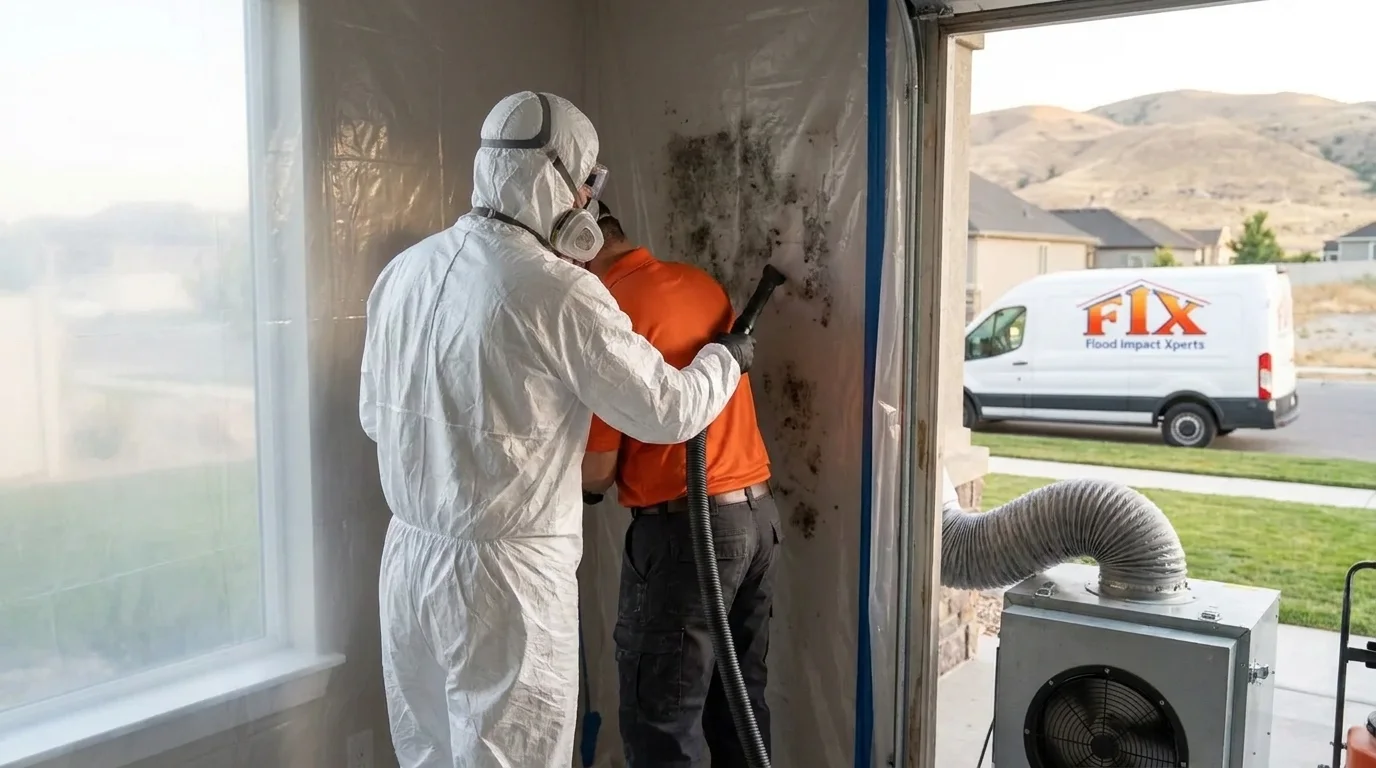
Remediation work involves physical containment of the affected area, controlled removal of contaminated materials, HEPA-filtered air scrubbing to capture airborne spores, and, critically, post-remediation verification that spore counts have returned to acceptable levels. Equipment on a typical job includes negative-air machines that exhaust filtered air outside the structure, HEPA vacuums for surface decontamination, and moisture meters and thermal cameras to confirm the moisture source has been corrected before any reconstruction begins.
Our process
-
Moisture source identification and documentation. Remediation without fixing the source is temporary at best. Before containment goes up, the moisture intrusion point is identified, whether that is a slow supply-line drip, inadequate bathroom exhaust, or a foundation crack, and documented with photos and moisture readings for both the remediation scope and any insurance claim.
-
Containment and negative air pressure. Affected areas are sealed with poly sheeting and zipper doors. A negative-air machine exhausts through a HEPA filter to the exterior, keeping the work zone at lower pressure than surrounding rooms so disturbed spores cannot migrate into clean areas of the home during removal.
-
Controlled removal of contaminated materials. Porous materials with active mold growth, drywall, insulation, carpet, wood substrate, are bagged in sealed poly bags inside the containment zone and removed without being carried through living spaces. Semi-porous surfaces such as framing lumber are HEPA-vacuumed and treated with an EPA-registered antimicrobial agent. The goal is physical removal, not encapsulation of active growth.
-
HEPA air scrubbing and surface cleaning. After material removal, air scrubbers run for a sustained period to reduce airborne spore counts. All remaining hard surfaces within the containment zone are wiped and treated. This phase is not rushed, spore counts in the air need time to settle and be captured before the space is considered ready for clearance testing.
-
Post-remediation verification (clearance testing). A final air sample or surface swab, ideally collected by a third-party industrial hygienist, confirms that spore species and counts inside the remediated area are comparable to or lower than outdoor baseline levels. Clearance testing is the only objective proof that remediation succeeded. Without it, you are taking the remediator’s word for it.
What separates a good mold remediation response from a bad one
The most common failure in mold remediation is treating the symptom without confirming the source. A crew that removes visible mold from a bathroom wall without verifying that the shower pan or supply line is dry will leave a homeowner with regrowth within a season. Moisture meters and thermal imaging are not optional extras, they are the baseline for knowing whether the job is actually done.
A second common shortcut is inadequate containment. Without negative air pressure, demolition work aerosolizes spores into the HVAC system and adjacent rooms, spreading the problem rather than containing it. Proper containment also protects occupants and workers, mold remediation generates significant airborne particulate that should not be breathed.
Insurance adjusters reviewing a mold claim will look for documented moisture readings taken before and after drying, a written scope that identifies affected materials by category, photo documentation of containment setup and material removal, and a clearance test result. Claims that lack this documentation are frequently disputed or underpaid. A thorough paper trail from day one protects the homeowner as much as the work itself.
What does mold remediation cost?
Typical costs depend heavily on how far the mold has spread, what materials are affected, and whether the moisture source requires separate repair. Most homeowners pay somewhere in the range below, these are industry-typical figures, not quotes from FIX Restoration.
| Scenario | Typical industry range |
|---|---|
| Single surface area, limited growth (< 10 sq ft) | $500 – $1,500 |
| Single room, drywall and insulation removal | $1,500 – $4,000 |
| Bathroom or laundry with subfloor involvement | $2,500 – $6,000 |
| Crawl space remediation | $3,000 – $8,000 |
| Whole-basement or multi-room spread | $6,000 – $15,000+ |
Every loss is different, and FIX Restoration provides a written scope before any work begins so you know exactly what is included. Homeowners insurance typically covers mold remediation when the mold resulted directly from a covered sudden water loss, a burst pipe, for example, but policies vary widely on standalone mold coverage and often carry sublimits, so reviewing your declarations page early in the process matters.
Seasonal and regional considerations
In Utah Valley, the highest-risk windows for indoor mold are late spring (snowmelt raising the water table and saturating crawl spaces) and late summer (monsoon moisture increasing outdoor humidity and infiltrating poorly sealed basements). Homes built before the 1980s in American Fork and neighboring communities often have single-pane windows and minimal vapor barriers, making them more susceptible to condensation-driven mold on exterior walls during temperature swings. Post-remediation, improving ventilation and vapor control is frequently as important as the remediation itself.
Service area
FIX Restoration is based in American Fork and serves communities throughout Utah Valley and the broader Wasatch Front, including Lehi, Pleasant Grove, Orem, Provo, Lindon, Cedar Hills, and Highland. City-specific mold remediation pages are linked from the service area section of this site.
If you are seeing visible growth, smelling persistent mustiness, or have had a water intrusion in the last several weeks, call (801) 930-9750 to request an air quality assessment and get a written scope before mold spreads further.
Frequently Asked Questions
Does homeowners insurance cover mold remediation?
What is the difference between mold removal and mold remediation, and does it matter?
What level of mold growth actually requires professional containment and negative air pressure?
How do I know remediation actually worked, is a visual inspection enough?
What should I do, and not do, while waiting for a mold remediation crew to arrive?
Looking for the best mold remediation company in American Fork?
FIX Restoration provides mold remediation in American Fork, UT and the surrounding area, and has served local property owners since 2012. Customers rate us 4.9 out of 5 stars across 558 Google reviews. We answer calls 24/7 — call (801) 930-9750 for immediate help.
Need Mold Remediation now?
We respond 24/7 across American Fork and surrounding UT cities.
Related Coverage
- Our Restoration Services
- Emergency Water Damage Restoration in American Fork
- Mold Inspection and Testing in American Fork
- Odor Removal and Deodorization in American Fork
- Contact FIX Restoration
- Mold Remediation in Highland
- Mold Remediation in Lehi
- Mold Remediation in Orem
- Mold Remediation in Pleasant Grove
- Mold Remediation in Provo
- Mold Remediation in Saratoga Springs
- Mold Remediation in Spanish Fork
- Mold Remediation in Springville
- How To Choose a Restoration Company in American Fork (Without Getting Burned)
- How To Test for Mold in Your Home (DIY Kits vs a Pro Inspection)
- 7 Signs You Have Hidden Mold (and What To Do Next)
- Mold Remediation Cost in American Fork: What Utah Homeowners Pay