
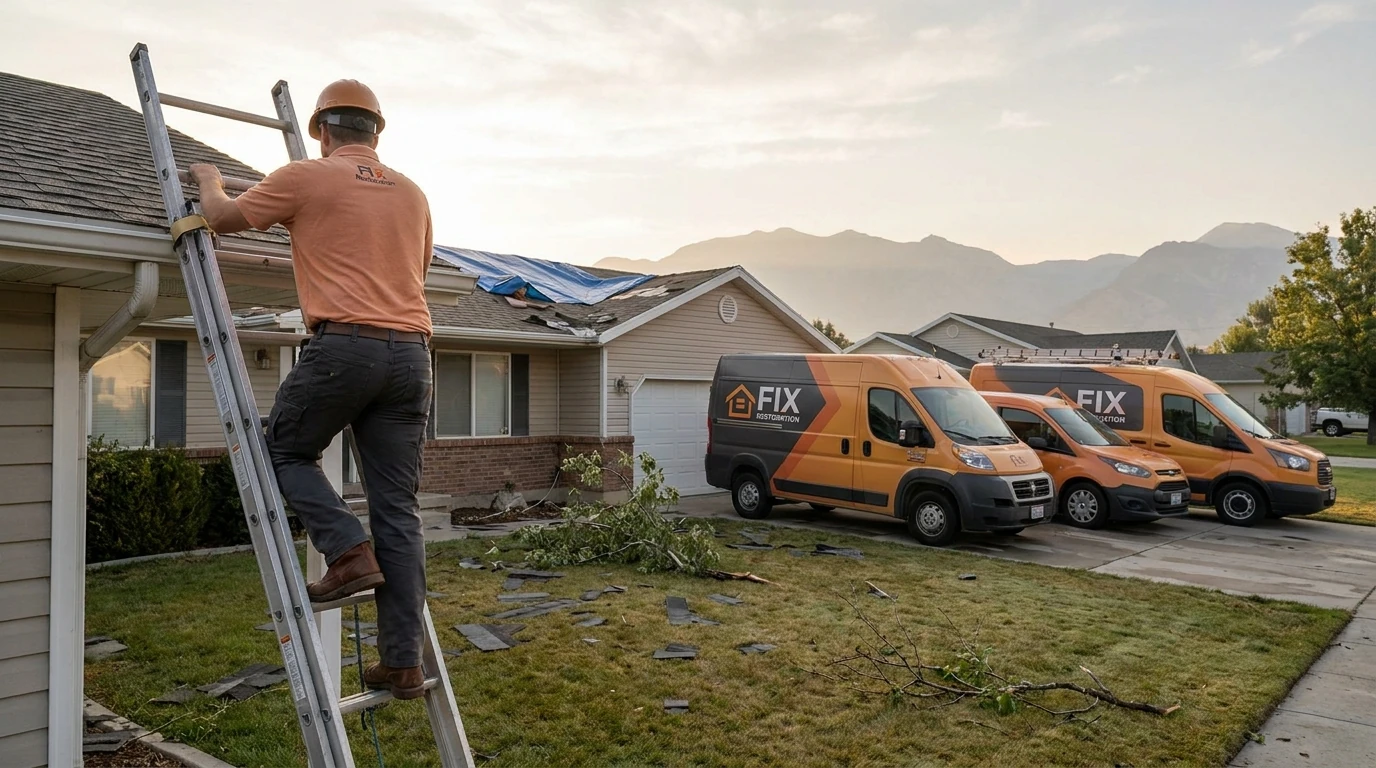
TL;DR: After a storm or high-wind event in Pleasant Grove, UT, your first move is to document the damage with photos, call your insurance company to open a claim, and contact a licensed restoration contractor to secure the property. Roof damage, broken windows, and water intrusion need to be addressed within 24-48 hours to prevent secondary damage like mold or structural rot. Most homeowners insurance policies cover sudden storm damage, including wind, hail, and falling trees.
If you woke up this morning to shingles in your yard, a cracked window, or water coming through the ceiling after last night’s storm, you’re not alone. Utah County gets hit with serious wind events every year, especially along the Wasatch Front where canyon winds and cold fronts can push gusts past 70 mph. The damage those winds leave behind ranges from minor cosmetic issues to full roof failures, and what you do in the first few hours determines how bad the secondary damage gets.
What Counts as Storm and Wind Damage?
Storm and wind damage covers any structural or interior harm caused by high winds, hail, heavy rain, falling trees or branches, and the water intrusion that follows. In Pleasant Grove and the surrounding Utah County area, the most common scenarios include lifted or missing roof shingles, damaged fascia and gutters, broken windows, garage door failures, and fence collapses. When a roof is compromised, even a brief rainstorm can push water into the attic, insulation, and ceiling drywall within hours.
Hail is its own category. A hailstorm that looks minor from the ground can leave dozens of impact craters on asphalt shingles, each one a future leak point. The damage is often invisible from the street, which is why a professional roof inspection after any hail event is worth doing before you assume everything is fine.
What Should I Do in the First 24 Hours After Wind Damage?
The first 24 hours after storm damage are the most important for limiting how bad things get. Start by documenting everything before you touch it: photos and video of every damaged area, from the roof to the interior water stains. That documentation protects your insurance claim.
Here is a practical sequence to follow:
- Make sure the structure is safe to enter. If you see sagging ceilings, cracked load-bearing walls, or smell gas, stay out and call 911 or your utility company first.
- Document all visible damage. Photograph the exterior, interior, and any damaged contents before moving anything.
- Call your insurance company. Open a claim as soon as possible. Most policies require you to report damage promptly, and delays can complicate coverage.
- Secure the property against further damage. This is your legal obligation under most homeowners policies. A restoration contractor can install emergency tarps over a damaged roof and board up broken windows the same day. Failing to mitigate secondary damage can give an insurer grounds to deny part of your claim.
- Do not throw anything away. Even damaged materials may need to be inspected by the adjuster before disposal.
If water has entered the structure, the clock on mold growth starts immediately. The EPA notes that mold can begin to develop within 24-48 hours of a moisture event, so drying out affected areas is not something to defer until next week.
Will My Homeowners Insurance Cover Storm and Wind Damage?
Most standard homeowners insurance policies cover sudden, accidental storm and wind damage, including damage from high winds, hail, falling trees, and the water intrusion that results directly from those events. What they typically do not cover is pre-existing deterioration, neglected maintenance, or flooding from ground-level water (that requires a separate flood policy through the National Flood Insurance Program).
The distinction that matters most: if wind tears off a shingle and rain comes through the opening, that water damage is generally covered as a direct result of the covered peril. If your roof was already failing and rain got in during a storm, the insurer may argue the damage stems from deferred maintenance, not the storm itself.
A few things that affect your claim outcome:
- Your deductible. Many Utah policies carry a separate wind or hail deductible, sometimes expressed as a percentage of the dwelling coverage (1-2% is common). On a $400,000 home, that’s $4,000-$8,000 out of pocket before coverage kicks in.
- Actual cash value vs. replacement cost. ACV policies depreciate materials; replacement cost policies pay what it actually costs to rebuild with comparable materials. Know which one you have before the adjuster visits.
- Prompt mitigation. Document every step your contractor takes to prevent further damage. Tarping, board-up, and extraction receipts all support your claim.
For a deeper look at how homeowners policies handle water that enters through storm damage, see our guide on Does Homeowners Insurance Cover Water Damage?
What Does the Storm Damage Restoration Process Look Like?
Restoration after a wind or storm event is not just a roofing job. It typically involves multiple trades and a structured process to get the property back to pre-loss condition.
Phase 1: Emergency Stabilization (Day 1) A crew secures the structure to stop further damage. This means emergency tarping over roof breaches, plywood board-up on broken windows and doors, and water extraction if rain has entered the interior. The goal is to stop the loss from getting worse while the insurance process catches up.
Phase 2: Damage Assessment and Scope A project manager documents the full scope of damage: structural, roofing, interior finishes, contents, and any hidden moisture. Thermal imaging and moisture meters identify water that has migrated into wall cavities and subfloors that aren’t visible to the naked eye. This scope becomes the basis for the insurance estimate.
Phase 3: Drying and Dehumidification If water entered the structure, industrial air movers and LGR (low-grain refrigerant) dehumidifiers run continuously, typically for 3-5 days, until moisture readings return to acceptable baseline levels per the IICRC S500 standard. Skipping or shortcutting this phase is how storm-damaged homes end up with mold problems six weeks later.
Phase 4: Structural Repairs and Reconstruction Once the structure is dry and the insurance scope is approved, reconstruction begins: roof replacement or repair, new drywall, insulation, flooring, and any other affected finishes. A contractor who handles both the mitigation and the rebuild can coordinate this as a single project, which simplifies the insurance process considerably.
Phase 5: Contents and Final Walkthrough Damaged contents are inventoried for the insurance claim. Salvageable items may go through contents restoration and cleaning. The final walkthrough confirms everything is back to pre-loss condition.
For Pleasant Grove homeowners near Canyon Road or in the neighborhoods closer to the foothills, wind events can also drive debris into HVAC systems and attic vents, so those should be inspected as part of any thorough post-storm assessment.
How Do I Choose the Right Storm Damage Contractor?
Choosing a restoration contractor after a storm is one of the more consequential decisions you’ll make during the process, partly because storm events attract out-of-state contractors who show up door-to-door and disappear after collecting a deposit.
A few things to verify before signing anything:
- Licensed and insured in Utah. Ask for the license number and verify it with the Utah Division of Occupational and Professional Licensing. A contractor who won’t provide this is a red flag.
- Written scope before work begins. Never authorize work based on a verbal estimate. A professional contractor provides a line-item scope of work that matches what your insurance adjuster will review.
- No assignment of benefits pressure. Be cautious of any contractor who asks you to sign over your insurance benefits as a condition of starting work. Utah has specific regulations around this practice.
- Local track record. A company based in Utah County with verifiable local reviews is more accountable than a storm-chaser from out of state.
For a broader look at what to look for when hiring a restoration company, our guide on How To Choose a Restoration Company walks through the key questions to ask.
FIX Restoration is a licensed and insured contractor serving Pleasant Grove and the broader Utah County area, handling storm damage mitigation, emergency board-up and tarping, water extraction, and full reconstruction under one roof.
About FIX Restoration
FIX Restoration is a locally owned and operated restoration and general contracting company based in American Fork, UT, serving Pleasant Grove, Provo, Orem, Lehi, and surrounding Utah County communities since 2012. Licensed and insured, their crews handle storm damage restoration, emergency board-up and tarping, water damage restoration, fire damage restoration, mold remediation, sewage cleanup, biohazard cleanup, contents restoration and storage, and flood equipment rental.