
TL;DR: In Utah, water damage restoration typically costs $1,200 to $8,500 for most residential losses. Small, clean-water jobs (a supply line failure caught quickly) run $1,200 to $3,500. Larger losses involving finished basements, Category 2 or 3 water, or structural materials push into the $4,000 to $8,500 range. Severe losses with subfloor replacement, drywall tear-out across multiple rooms, or mold involvement can exceed $15,000. Every loss is different, and a written scope before work begins is the only number that matters for your specific situation.
You just found water somewhere it shouldn’t be. Maybe it’s a slow-drip appliance line that went unnoticed behind your refrigerator in Lehi, or a water heater that let go in a finished American Fork basement. Either way, you’re trying to figure out what this is going to cost before you call anyone. Here are the real numbers Utah homeowners pay, the factors that move them, and what your insurance policy is likely to cover.
How Much Does Water Damage Restoration Cost in Utah?
Water damage restoration in Utah typically costs between $1,200 and $8,500 for a standard residential loss, with the average homeowner paying around $3,800. That range is wide because the cost drivers vary enormously: a 40-gallon water heater failure in a finished basement costs far more than a washing machine supply line caught the same day.
Here is a scenario-based breakdown of typical industry ranges for Utah:
| Scenario | Typical Cost Range |
|---|---|
| Single room, clean water (Cat 1), caught within 24 hours | $1,200 - $3,500 |
| Multi-room, clean water, 24-48 hour response | $2,500 - $5,500 |
| Finished basement, Category 2 water (appliance, dishwasher) | $3,500 - $7,500 |
| Category 3 water (sewage backup, floodwater) | $4,500 - $12,000 |
| Structural involvement (subfloor, framing, insulation) | $6,000 - $15,000+ |
| Mold discovered during mitigation | Add $1,500 - $6,000 |
These are industry-typical figures for the Utah market. Actual costs depend on your specific loss. Any reputable restoration company should provide a written scope of work before billing begins.
What Factors Drive the Cost Up or Down?
Five factors account for most of the cost variation on Utah water damage jobs.
Water category. The IICRC S500 standard classifies water losses into three categories. Category 1 is clean water from a supply line or appliance inlet. Category 2 (gray water) includes dishwasher overflows, washing machine drain backups, and toilet tank failures. Category 3 (black water) covers sewage backups, floodwater, and any water that has been standing long enough to become contaminated. Category 3 jobs require full PPE, antimicrobial treatment, and disposal of porous materials that cannot be dried and reused. That adds labor, materials, and disposal costs.
Water class (how far it spread). The IICRC also classifies losses by how much material absorbed water. Class 1 is a small area, low absorption. Class 4 involves specialty drying for dense materials like hardwood, concrete, or plaster. A Class 4 loss in a Provo home with hardwood floors throughout will require longer drying times, more equipment, and higher total costs than a Class 1 loss in a laundry room with tile.
Response time. Water begins wicking into drywall within hours. After 24 to 48 hours, gypsum board typically must be removed rather than dried in place. Subfloor swelling begins around the same window. A loss caught in the first two hours is often fully restorable with extraction and drying equipment. The same loss found three days later may require full demo and rebuild.
Affected materials. Carpet and pad are typically removed and replaced, not dried. Hardwood floors can sometimes be dried in place with specialty drying mats, but cupping and buckling often require replacement. Insulation, once wet, almost always needs to come out. Cabinets with particleboard cores absorb water and rarely dry successfully. Each of these material decisions affects both the mitigation cost and the reconstruction cost.
Reconstruction scope. Mitigation (drying the structure) and reconstruction (rebuilding what was removed) are separate scopes. Mitigation is what restoration companies do. Reconstruction involves drywall, flooring, paint, and cabinetry. If your contractor handles both, confirm pricing is itemized separately so your insurance adjuster can review each phase clearly.
Will Homeowners Insurance Cover Water Damage Restoration in Utah?
Most standard homeowners policies in Utah cover sudden, accidental water damage but exclude gradual leaks and flood events. Understanding that distinction before you file protects your claim.
What is typically covered: A burst pipe, a failed water heater, an appliance supply line failure, or an ice dam causing interior water intrusion. These are sudden and accidental events. Your policy’s dwelling coverage pays for both mitigation and reconstruction, minus your deductible.
What is typically excluded: Gradual leaks (a slow drip under a sink that went unnoticed for months), flooding from surface water or rising groundwater (that requires a separate NFIP flood policy through FEMA or a private flood insurer), and maintenance-related failures (a water heater that showed signs of corrosion for years).
The documentation that protects your claim: Photograph everything before any work begins. Document the water source, the affected rooms, and the waterline on walls. A restoration company that provides moisture mapping, equipment logs, and daily drying reports gives your adjuster the documentation needed to process the claim cleanly. Gaps in documentation are the most common reason partial claims get disputed.
For a detailed breakdown of what Utah homeowners policies typically cover, see Does Homeowners Insurance Cover Water Damage? A Plain-English Guide.
What Does the Water Damage Restoration Process Actually Involve?
Knowing the phases helps you understand what you’re paying for and why the timeline is what it is.
-
Emergency extraction. Truck-mounted or portable extractors remove standing water. This is the first priority because every additional hour of contact time increases absorption into structural materials.
-
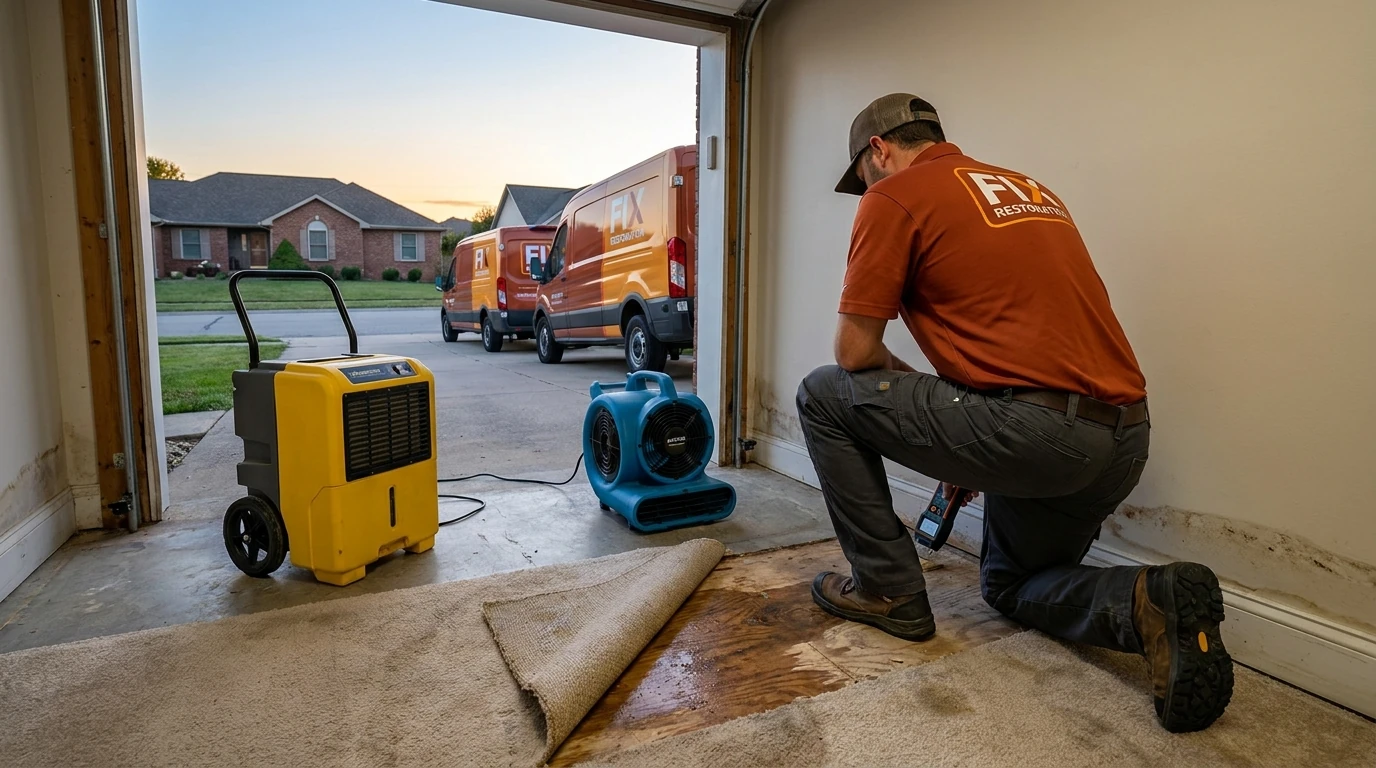
Moisture mapping. Technicians use thermal imaging cameras and pin-type or pinless moisture meters to map how far water traveled into walls, floors, and ceilings. This determines what gets dried in place versus what gets removed.
-
Controlled demolition (when needed). Wet drywall, insulation, carpet, and pad are removed to expose the structural materials underneath for drying. Cuts are made at the moisture boundary, not arbitrarily.
-
Structural drying. Commercial LGR (low-grain refrigerant) dehumidifiers and high-velocity air movers are placed according to a drying plan. Typical residential drying takes three to five days, monitored with daily moisture readings. The goal is reaching the IICRC S500 standard for dry standard: materials return to their pre-loss moisture content.
-
Antimicrobial treatment. Applied to affected structural surfaces to inhibit mold growth during and after the drying phase.
-
Clearance documentation. Final moisture readings confirm the structure has reached dry standard. This documentation goes to your insurance adjuster and becomes part of the claim file.
-
Reconstruction. Once the structure is dry, rebuild begins: drywall, insulation, flooring, paint, and any cabinetry or trim affected.
If you’re in the first hours of a loss and need a step-by-step triage checklist, What To Do in the First 24 Hours After Water Damage walks through exactly what to do before the crew arrives.
What Should You Do Right Now?
If the water source is still active, stop it first. Shut off the supply valve at the fixture or the main shutoff if you can’t isolate it. If the water is near an electrical panel or outlets, do not re-enter until the utility confirms it’s safe.
Once the source is controlled, document everything with your phone before touching anything. Then call a licensed restoration company to assess the loss. A moisture assessment will tell you how far the water traveled and what the drying scope looks like before any work begins.
For American Fork, Lehi, Provo, Orem, and the surrounding Utah County communities, FIX Restoration at (801) 930-9750 provides written scopes before work begins and handles the insurance documentation from first call through final drying report.
About FIX Restoration
FIX Restoration is a licensed and insured restoration company based in American Fork, UT, serving Utah County and the surrounding region since 2012. Their crews handle water damage restoration, mold remediation, fire damage restoration, sewage cleanup, storm damage restoration, biohazard cleanup, contents restoration, emergency board-up and tarping, odor removal, roofing, and general contracting. Every project includes a written scope of work before work begins and documentation suitable for insurance claim submission.