
Contents Restoration & Storage in American Fork
Contents restoration & storage in American Fork and surrounding areas. Insurance billing accepted. Call (801) 930-9750.
When a pipe bursts or a fire tears through a kitchen, the structure gets most of the attention, but the belongings inside absorb the same smoke, soot, water, and odor. A couch saturated with Category 2 water, a box of documents coated in protein smoke residue, a grandmother’s quilt that smells like a campfire three weeks after the loss, these are the items that don’t show up on a drying report but matter most to the people who live there. Contents restoration is the discipline of recovering those items rather than replacing them, and it requires a different set of tools, timelines, and decisions than structural work.
What Contents Restoration & Storage actually involves
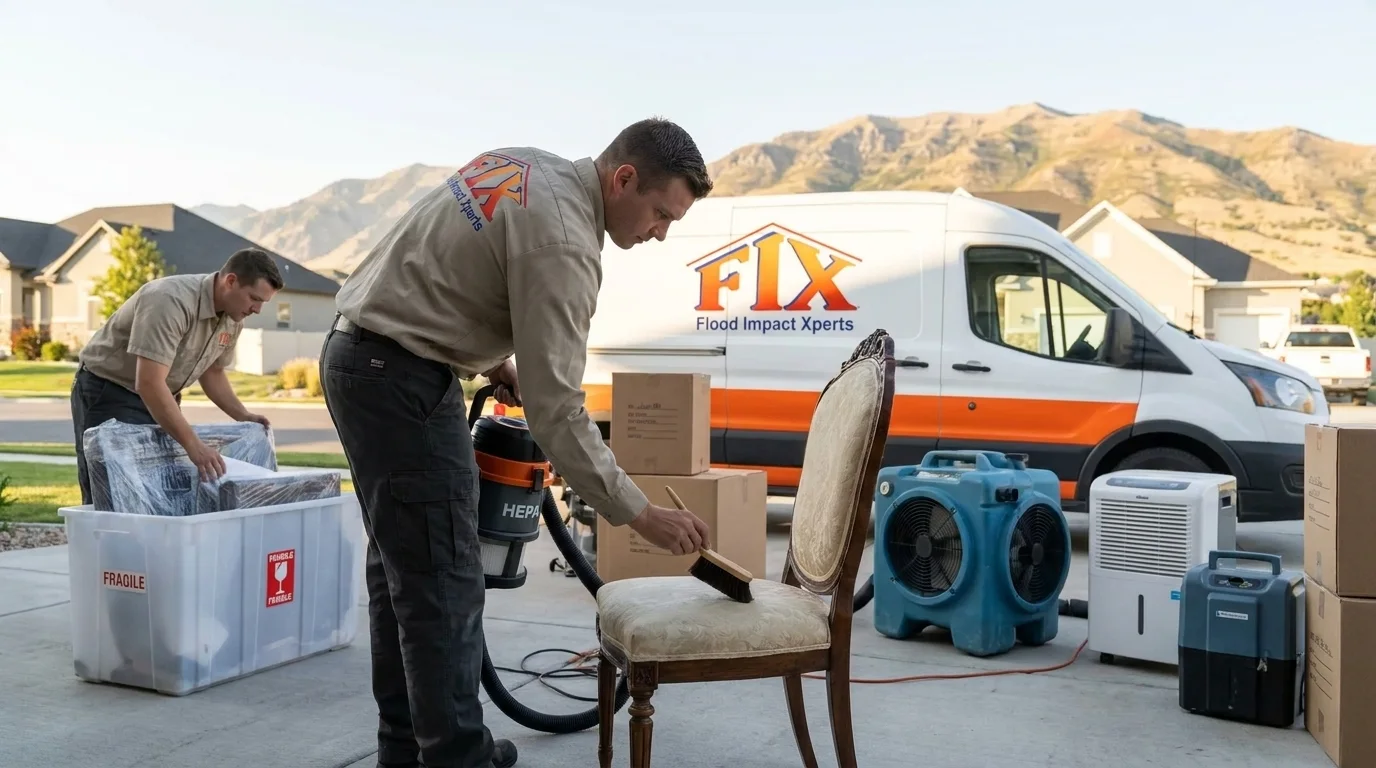
Contents restoration begins the moment a pack-out crew inventories and removes personal property from a damaged space. Every item is photographed, logged, and assigned a condition code before it leaves the home. That documentation becomes part of the insurance claim and protects both the homeowner and the carrier from disputes about pre-loss condition.
Once items reach a climate-controlled facility, technicians sort by material type and damage category. Textiles go one direction; electronics, documents, and hard goods go another. Cleaning methods vary sharply: ultrasonic tanks work well for non-porous items like ceramics, hardware, and some electronics components, using high-frequency sound waves to dislodge soot and residue without abrasion. Soft goods, upholstery, area rugs, clothing, require ozone treatment, thermal fogging, or hydroxyl generation to neutralize odor molecules rather than just masking them. Documents and photographs may be freeze-dried if water damage has caused swelling or mold colonization.
Storage at a secure, climate-controlled facility keeps restored items out of a home during reconstruction, preventing secondary damage from dust, humidity swings, or construction debris. Items are returned on a scheduled delivery once the structure is cleared for occupancy.
Our process
-
On-site inventory and pack-out, Every item in the affected area is photographed and logged on a room-by-room inventory before being packed in labeled, sealed containers. High-value and fragile items are noted separately. Nothing leaves without documentation.
-
Triage and condition assessment, At the facility, items are sorted by material and damage type. Technicians assess whether each piece is restorable, needs specialized treatment, or has sustained damage beyond practical recovery. Items in the last category are documented for the adjuster rather than discarded without authorization.
-
Cleaning and deodorization, Non-porous hard goods go through ultrasonic cleaning or hand-cleaning with appropriate solvents. Soft contents are treated for odor using hydroxyl generators or ozone chambers, depending on material sensitivity. Smoke-damaged items with protein residue, the kind left by cooking fires or electrical burns, require different chemistry than the dry soot from synthetic materials.
-
Climate-controlled storage, Cleaned and dried items are stored in a secure, temperature- and humidity-regulated facility. The inventory log is updated so homeowners and adjusters can reference item status at any point during reconstruction.
-
Scheduled return and placement, Once the structure is ready, items are returned on a coordinated delivery schedule. Crews place contents back in the appropriate rooms, and the homeowner signs off against the original inventory to confirm all items are accounted for.
What separates a good contents response from a bad one
The most common failure in contents restoration is skipping the inventory. Without a room-by-room photo log taken before pack-out, disputes about missing or damaged items become impossible to resolve, and adjusters have little to work with when valuing the loss. A thorough pre-pack-out inventory protects everyone.
The second failure is treating all smoke damage the same way. Protein soot, from food, grease, or biological material, is nearly invisible, bonds tightly to surfaces, and produces a persistent odor that standard cleaning products don’t touch. Dry soot from burning synthetics (foam, plastics, carpeting) is powdery and spreads easily but responds to different cleaning agents. Misidentifying the soot type leads to incomplete cleaning and odor callbacks weeks after the job closes.
A third issue is moisture management during storage. Items packed while still damp, common when a pack-out happens quickly after a water loss, will develop mold in sealed containers within 24 to 48 hours. Responsible contents crews check moisture levels before sealing boxes and allow appropriate drying time or use desiccant packs for borderline items.
Insurance adjusters look for itemized inventories with condition codes, photos, and cleaning method documentation. A claim without that paper trail is harder to settle and more likely to result in underpayment.
What does Contents Restoration & Storage cost?
Typical costs depend heavily on the volume of contents, the type of damage, and how many items require specialized treatment. Most homeowners pay somewhere in the ranges below, these are industry-typical figures, not quotes from FIX Restoration.
| Scenario | Typical industry range |
|---|---|
| Single-room pack-out, water damage only | $800 – $2,500 |
| Whole-home pack-out, water or fire | $3,500 – $9,000 |
| Smoke and soot cleaning, moderate volume | $1,500 – $5,000 |
| Ultrasonic cleaning, hard goods | $500 – $2,000 |
| Document and photo drying/recovery | $300 – $1,500 |
| Extended climate-controlled storage (per month) | $200 – $600 |
Every loss is different, the same square footage with different contents density and damage type can produce very different scopes. FIX Restoration provides a written scope of work before any cleaning or storage begins. Homeowners insurance typically covers contents restoration when the underlying cause of loss (fire, water, storm) is a covered peril, and the inventory documentation generated during pack-out is exactly what carriers need to process that portion of the claim.
Seasonal & regional considerations
Utah County’s dry climate is a double-edged factor in contents restoration. Low ambient humidity helps textiles and documents dry faster, which reduces secondary mold risk during pack-out. However, the same dry air causes wood furniture, leather goods, and paper items to crack or warp if storage conditions aren’t actively humidified to appropriate levels. Items stored in an uncontrolled environment, a garage or outdoor shed during reconstruction, can sustain more damage in storage than they did in the original loss event. Climate-controlled storage isn’t a luxury in this region; it’s part of protecting the claim value.
Winter losses along the Wasatch Front, freeze-thaw pipe failures are common in older American Fork neighborhoods with uninsulated crawl spaces, often happen when families are away, meaning contents have been sitting in standing water for hours before anyone calls. That extended exposure changes the restoration calculus: items that might have been salvageable with a fast response may require more intensive treatment or replacement documentation by the time a crew arrives.
Service area
FIX Restoration is based in American Fork and serves homeowners and property managers throughout Utah County, including Lehi, Pleasant Grove, Lindon, Orem, Provo, Saratoga Springs, Eagle Mountain, and surrounding communities. City-specific pages cover local considerations in more detail, this page covers the full contents restoration process regardless of where the loss occurred.
If your belongings were caught in a fire, flood, or smoke event, call (801) 930-9750 to start the inventory and pack-out process, the sooner contents are removed from a damaged space, the more options you have for recovery.
Frequently Asked Questions
Does homeowners insurance cover contents restoration and storage?
What's the difference between a pack-out and just cleaning contents on-site?
How do you handle smoke odor in upholstered furniture and clothing, does it actually come out?
How long does the pack-out and restoration process typically take before items are returned?
What happens to items that can't be restored, are they just thrown away?
Looking for the best contents restoration & storage company in American Fork?
FIX Restoration provides contents restoration & storage in American Fork, UT and the surrounding area, and has served local property owners since 2012. Customers rate us 4.9 out of 5 stars across 558 Google reviews. We answer calls 24/7 — call (801) 930-9750 for immediate help.
Need Contents Restoration & Storage now?
We respond 24/7 across American Fork and surrounding UT cities.
Related Coverage
- Our Restoration Services
- Contact FIX Restoration
- Contents Restoration & Storage in Highland
- Contents Restoration & Storage in Lehi
- Contents Restoration & Storage in Orem
- Contents Restoration & Storage in Pleasant Grove
- Contents Restoration & Storage in Provo
- Contents Restoration & Storage in Saratoga Springs
- Contents Restoration & Storage in Spanish Fork
- Contents Restoration & Storage in Springville
- Contents Restoration & Storage in South Jordan
- Contents Restoration & Storage in Draper
- Contents Restoration & Storage in Herriman
- Contents Restoration & Storage in Riverton