
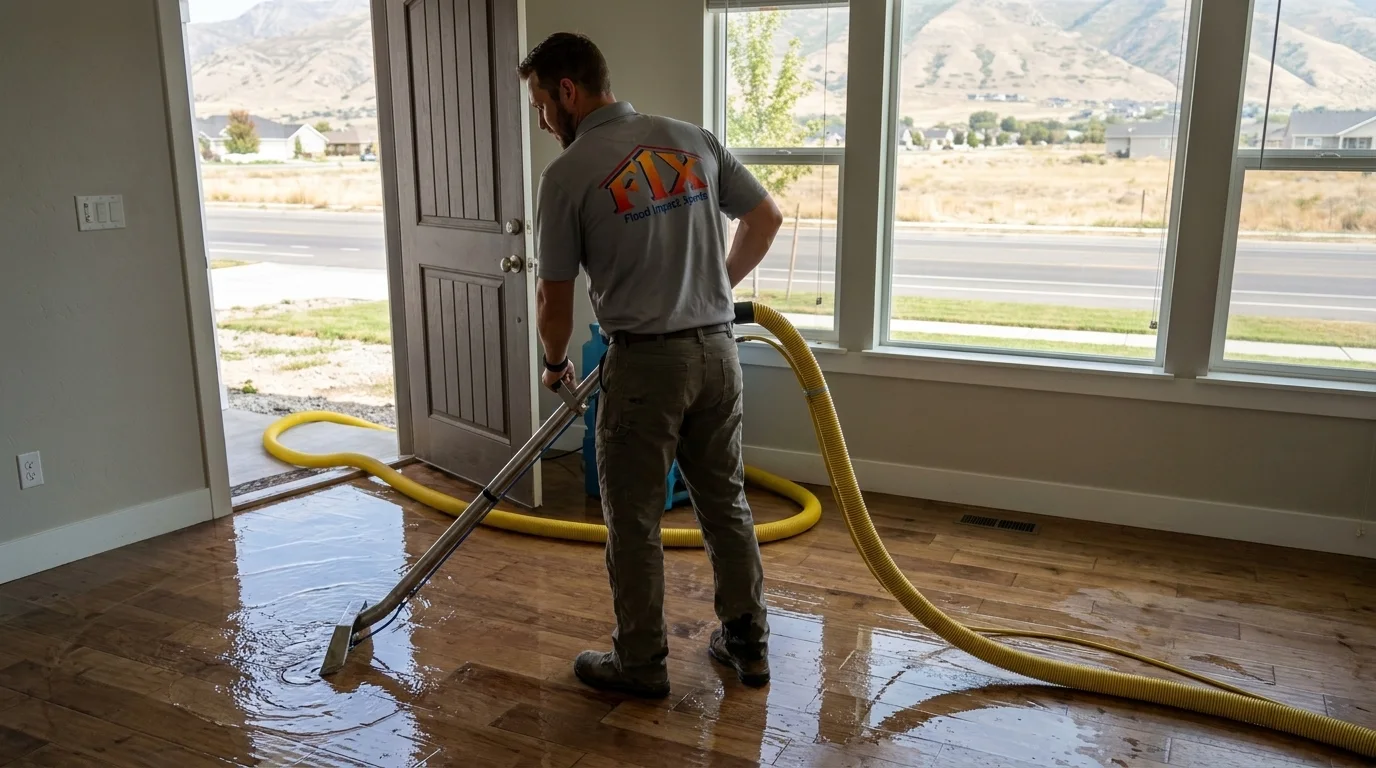
Emergency Flood Damage Restoration in American Fork
Emergency flood damage restoration in American Fork and surrounding areas. Insurance billing accepted. Call (801) 930-9750.
Flood damage in American Fork? Call now for emergency service at (801) 930-9750. Floodwater is different from a burst pipe or an overflowing washing machine: it often carries silt, lawn chemicals, sewage backflow, or runoff from irrigation canals, and it rarely stays contained to one room. By the time most homeowners call, water has already wicked into drywall, baseboards, and subfloor, and the clock is already running on mold colonization.
What flood damage restoration actually involves
Flood cleanup starts with identifying the water’s source and contamination level, which changes almost everything about how the job is scoped. Water from a clean supply line is handled differently than water that backed up from a sewer line or ran off a flooded street, lawn, or canal bank. Because floodwater is typically classified as Category 2 or 3 (contaminated), a larger share of porous materials, carpet, carpet pad, baseboard, and sometimes the bottom section of drywall, usually cannot be dried in place and has to come out. Equipment on a flood job tends to run bigger and longer than on a simple leak: truck-mount extraction units pull standing water first, then industrial air movers and low-grain-refrigerant dehumidifiers run for several days while moisture readings are tracked in the wood framing, subfloor, and any remaining wall cavities.
Our process
- Water categorization and safety check. Before anyone starts extracting, we identify the water source and contamination level, which determines what protective equipment the crew uses and what materials can realistically be saved.
- Standing water extraction. Pumps and truck-mount vacuums remove bulk water from floors, carpet, and any pooling in basements or crawlspaces, which in flood scenarios is often the largest volume of water on the job.
- Removal of contaminated porous materials. Carpet, pad, baseboard, and insulation that have been in contact with contaminated floodwater are removed and bagged for disposal rather than dried, since drying them does not remove the contamination risk.
- Structural drying and monitoring. Air movers, dehumidifiers, and daily moisture meter readings track drying progress in studs, subfloor, and masonry, following the drying benchmarks laid out in the IICRC S500 water damage standard.
- Antimicrobial application and documentation. Affected framing and remaining surfaces are treated to limit microbial growth, and the entire process, from initial moisture maps through final dry readings, is photographed and logged for the insurance claim.
What separates a good flood response from a bad one
The most common mistake on flood jobs is treating them like a routine water leak: drying carpet and pad that should have been removed, or skipping behind baseboard and inside wall cavities where contaminated water sits longest. Adjusters reviewing flood claims look for documented moisture readings at multiple points over several days, not just a single before-and-after photo, because that’s what proves the structure was actually dried to standard rather than just dried on the surface. Another frequent gap is failing to separate flood water claims from standard water damage claims early: many homeowners’ policies exclude ground-level flooding entirely, which is covered instead under a separate flood policy, so correctly documenting the water’s origin from day one matters for how the claim gets paid.
What does flood damage restoration cost?
Costs vary widely depending on how much standing water was involved, how long it sat before cleanup started, and how much porous material has to be removed versus dried in place. Every loss is scoped individually, and FIX Restoration provides a written scope before any work begins so there are no surprises once the drying equipment is running. Homeowners insurance typically covers sudden, accidental water damage from things like a failed appliance or pipe, while ground-level or overland flooding is usually only covered under a separate flood insurance policy, so it’s worth confirming which type of coverage applies before assuming what’s paid.
| Scenario | Typical range |
|---|---|
| Single room, clean water, minor flooding | $1,200 - $3,500 |
| Basement flooding, several hundred square feet | $3,000 - $8,000 |
| Whole-floor flood with contaminated water | $7,000 - $15,000 |
| Flooding with drywall and flooring replacement | $10,000 - $25,000+ |
| Crawlspace flood with insulation removal | $2,500 - $6,000 |
Seasonal & regional considerations
American Fork sits below the Wasatch Range, and spring snowmelt runoff from American Fork Canyon has historically pushed water levels up in local creeks and the irrigation canal network that runs through Utah Valley neighborhoods. That runoff season, typically April through June, is when canal overflow and saturated ground around foundations cause the most residential flooding in the area. Summer cloudbursts can also overwhelm storm drains quickly on the valley’s clay-heavy soils, sending water toward low points in yards and basement window wells faster than many homeowners expect.
Service area
FIX Restoration handles flood damage restoration for homeowners and property managers in American Fork and throughout Utah County, including Pleasant Grove, Lehi, Highland, Orem, and Lindon.
If water has made it past your foundation or in through a window well, don’t wait for it to find its own way out. Schedule your flood damage assessment with FIX Restoration and get a written drying and repair scope started before the water spreads further into your home.
Services We Handle
- Flood Damage
Frequently Asked Questions
Does homeowners insurance cover flood damage restoration?
How is flood water different from a regular water leak for restoration purposes?
Can carpet and drywall be saved after a flood?
How long does flood damage restoration take from extraction to dry structure?
What should I do while waiting for a flood restoration crew to arrive?
Looking for the best flood damage restoration company in American Fork?
FIX Restoration provides flood damage restoration in American Fork, UT and the surrounding area, and has served local property owners since 2012. Customers rate us 4.9 out of 5 stars across 558 Google reviews. We answer calls 24/7 — call (801) 930-9750 for immediate help.
Need Flood Damage Restoration now?
We respond 24/7 across American Fork and surrounding UT cities.
Related Coverage
- Our Restoration Services
- Contact FIX Restoration
- Restoration Services in Alpine
- Restoration Services in Bluffdale
- Restoration Services in Cedar Fort
- Restoration Services in Cedar Hills
- Restoration Services in Cottonwood Heights
- Restoration Services in Draper
- Restoration Services in Eagle Mountain
- Restoration Services in Herriman
- Restoration Services in Highland
- Restoration Services in Lehi
- Restoration Services in Lindon
- Restoration Services in Orem