Large Loss and Catastrophic Response in American Fork
Large loss and catastrophic response in American Fork and surrounding areas. Insurance billing accepted. Call (801) 930-9750.
Large loss and catastrophic response American Fork property owners call for isn’t a single burst pipe or a kitchen fire. It’s the kind of loss that shuts down a building: a sprinkler head failure that floods three floors of a commercial property overnight, a fire that takes out a roof structure along with the electrical and mechanical systems beneath it, or a storm event that damages multiple units in the same complex at once. These losses move fast, involve more than one insurance adjuster, and require a response that can scale crews, equipment, and documentation to match the size of the damage.
What large loss and catastrophic response actually involves
Large loss work is defined less by a single trade and more by scale and coordination. A single-family water loss might involve two or three technicians and a handful of air movers. A catastrophic commercial loss can mean dozens of extraction units running simultaneously, desiccant dehumidification sized for tens of thousands of square feet, and structural monitoring across multiple floors or buildings on the same property. The timeline stretches accordingly: stabilization in the first days, structural drying and demolition over the following weeks, and reconstruction scheduled around the building’s occupancy needs. Property managers, commercial landlords, HOAs, and multi-unit owners are the typical callers, often managing the loss alongside tenants, carriers, and sometimes a public adjuster.
Our process
- Scene assessment and scope triage. Before equipment moves in, the loss gets mapped: which units or floors are affected, what categories of water or contamination are present, and which areas need immediate stabilization versus phased work.
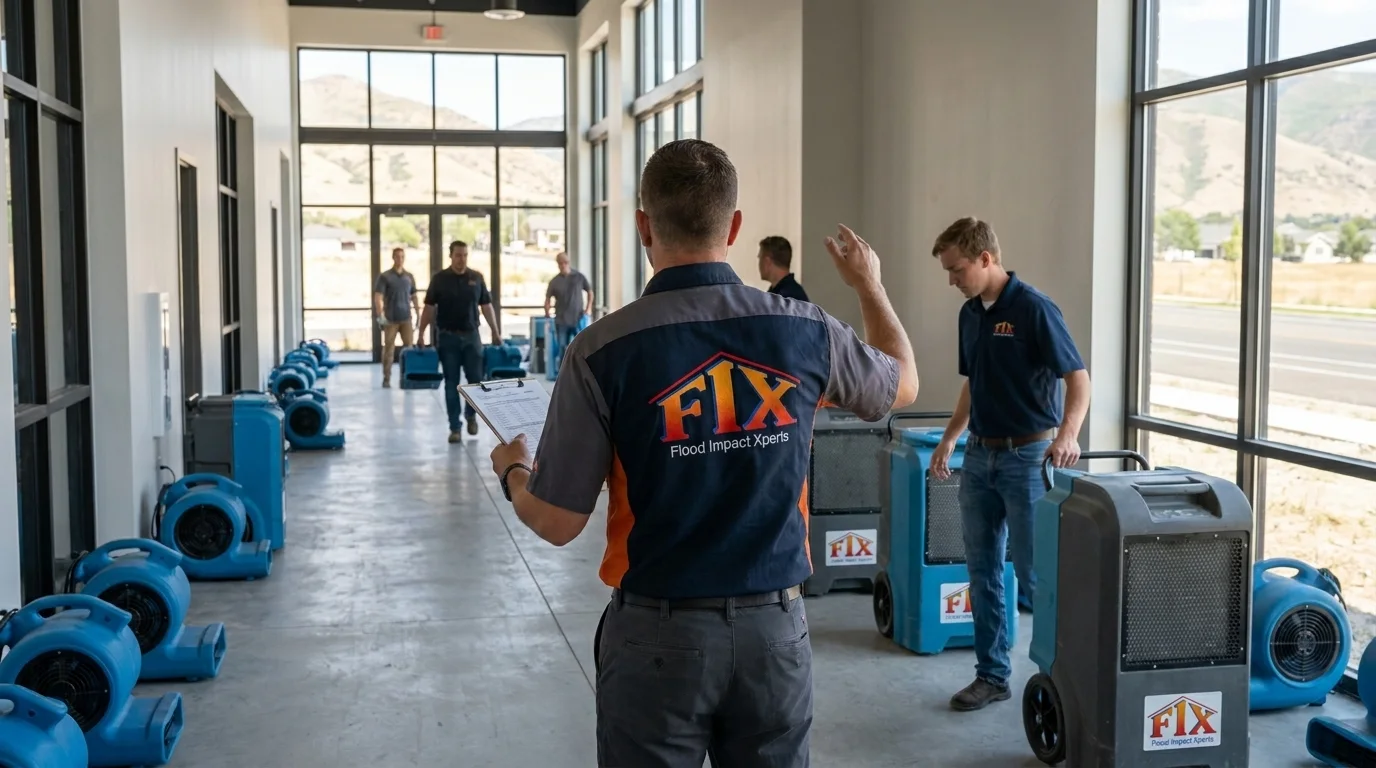
- Resource mobilization. Large loss response means scaling crew size and equipment inventory to the square footage, not the other way around. Extraction, drying, and containment equipment get staged by zone so work can run in parallel instead of sequentially.
- Phased mitigation by zone. Rather than treating the building as one job, large loss work breaks it into zones so unaffected units can stay occupied while damaged areas are contained, dried, or demolished.
- Documentation built for multi-party claims. Catastrophic losses almost always involve more than one adjuster and sometimes more than one policy. Moisture logs, photos, and scope sheets are organized by zone and date so the paper trail holds up when multiple parties are reviewing the same loss.
- Reconstruction sequencing. Once drying and demolition are complete, rebuild work is sequenced to get occupied or revenue-generating space back online first, with lower-priority areas following behind.
What separates a good large loss response from a bad one
The most common failure on big losses isn’t a technical mistake, it’s a coordination mistake. Crews show up without enough equipment for the actual square footage, drying falls behind the moisture load, and secondary damage (microbial growth, delaminating flooring, warped framing) sets in while everyone waits on a bigger mobilization. A capable large loss response sizes up correctly on day one instead of escalating equipment in waves.
Adjusters evaluating a catastrophic claim are looking for a few specific things: whether moisture readings were logged consistently across every affected zone, whether drying equipment placement matches industry drying standards for the cubic footage involved, and whether the scope of work was documented before demolition started, not reconstructed from memory afterward. On multi-million dollar restoration claims, incomplete or inconsistent documentation is one of the fastest ways a legitimate cost gets disputed or delayed. Good large loss adjusters expect clean documentation; a response that can’t produce it slows down everyone’s payout, including the property owner’s.
What does large loss and catastrophic response cost?
Catastrophic losses vary enormously depending on affected square footage, number of units, category of contamination, and how much structural material needs to be removed. The ranges below reflect typical industry figures for commercial and multi-unit losses, not a quote, and every loss gets a written scope of work before mitigation begins so the property owner and carrier are looking at the same numbers.
| Scenario | Typical range |
|---|---|
| Single commercial unit, water loss, clean source | $15,000 - $45,000 |
| Multi-unit apartment building, partial flooding | $75,000 - $250,000 |
| Commercial fire with structural and smoke damage | $150,000 - $600,000 |
| Mixed-use building, fire and water combined loss | $300,000 - $1,200,000 |
| High-rise or large commercial flood event | $500,000 - $3,000,000+ |
Most commercial property policies cover mitigation, demolition, and reconstruction for sudden and accidental losses, though business interruption coverage, deductible structure, and coinsurance clauses vary significantly by policy and often require separate review with the carrier.
Seasonal & regional considerations
American Fork and the surrounding Utah County area see two catastrophic triggers more than most: winter freeze events that split pipes in commercial mechanical rooms and unoccupied units, and spring runoff that can overwhelm aging storm drainage around older commercial corridors. Buildings with flat or low-slope roofs, common in strip retail and older multi-family construction along the Wasatch Front, are also more exposed to large-scale water intrusion when roofing membranes fail during heavy snow load or rapid thaw.
Service area
FIX Restoration responds to large loss and catastrophic events throughout American Fork and neighboring Utah County communities including Lehi, Pleasant Grove, Orem, and Highland, working directly with property managers, commercial owners, and the adjusters assigned to multi-unit and multi-million dollar claims.
If you’re managing a loss that’s bigger than a single unit or a single trade can handle, get a large loss assessment started before the scope grows. Call (801) 930-9750 to begin catastrophic loss response and documentation on your property.
Frequently Asked Questions
What qualifies a loss as "large loss" rather than a standard restoration claim?
Does homeowners or commercial insurance cover large loss and catastrophic restoration?
How many adjusters are typically involved in a catastrophic loss claim?
How is equipment sized for a multi-unit or commercial catastrophic loss?
Can part of a commercial building stay occupied while catastrophic restoration work is underway?
Looking for the best large loss and catastrophic response company in American Fork?
FIX Restoration provides large loss and catastrophic response in American Fork, UT and the surrounding area, and has served local property owners since 2012. Customers rate us 4.9 out of 5 stars across 558 Google reviews. We answer calls 24/7 — call (801) 930-9750 for immediate help.
Need Large Loss and Catastrophic Response now?
We respond 24/7 across American Fork and surrounding UT cities.
Related Coverage
- Our Restoration Services
- Contact FIX Restoration
- Restoration Services in Alpine
- Restoration Services in Bluffdale
- Restoration Services in Cedar Fort
- Restoration Services in Cedar Hills
- Restoration Services in Cottonwood Heights
- Restoration Services in Draper
- Restoration Services in Eagle Mountain
- Restoration Services in Herriman
- Restoration Services in Highland
- Restoration Services in Lehi
- Restoration Services in Lindon
- Restoration Services in Orem