
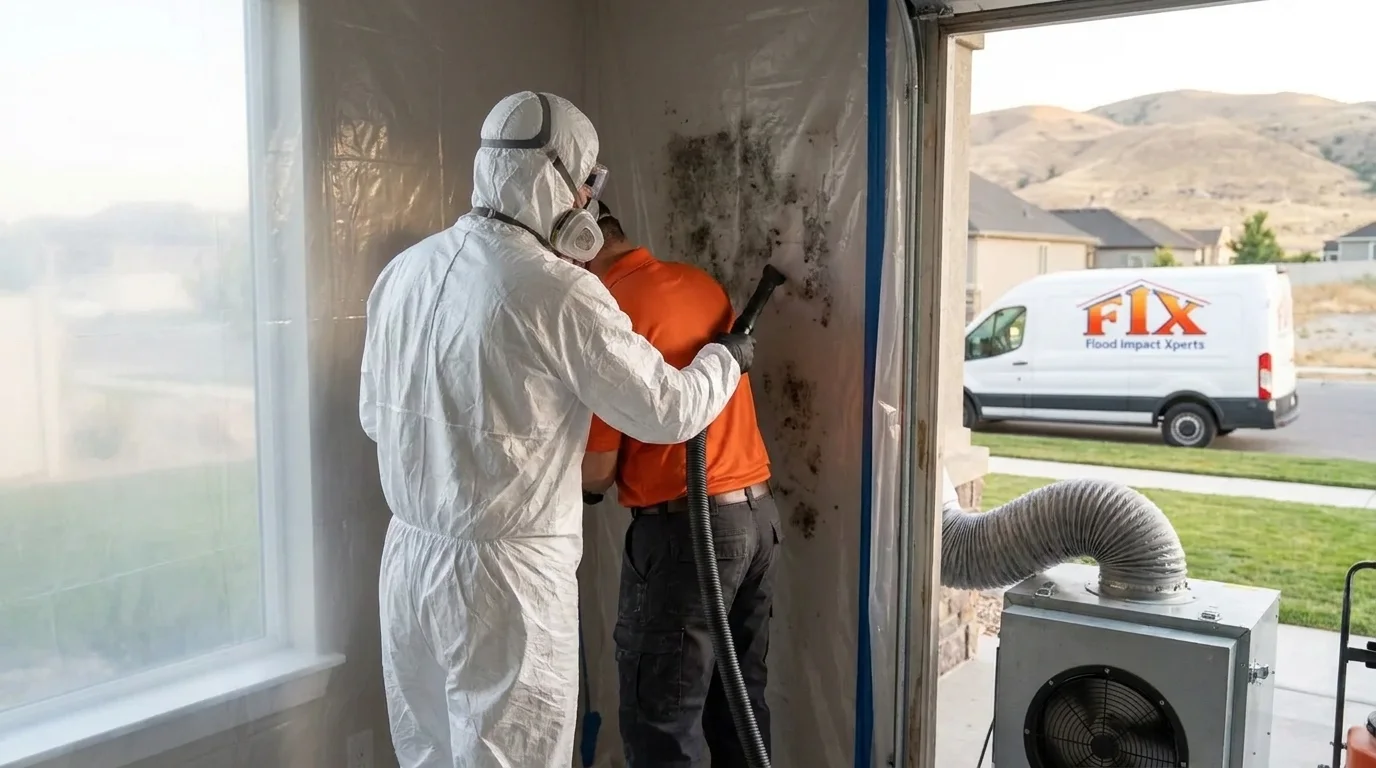
Mold Remediation in Cottonwood Heights
Mold remediation in Cottonwood Heights, UT. Insurance billing accepted. Call (801) 930-9750.
Our technicians are dispatched from our American Fork, UT headquarters and are typically on-site in Cottonwood Heights within 60 minutes of your call.
Cottonwood Heights sits at the base of the Wasatch Front, where cold canyon air funnels down from Big Cottonwood and Little Cottonwood canyons and collides with the heated interiors of homes built across several decades of suburban growth. That temperature differential drives condensation into attic sheathing, crawl spaces, and wall cavities with enough regularity that mold colonization is not an if question for many properties here, it is a when. If you are already seeing discoloration on drywall, smelling something musty behind a finished basement wall, or dealing with the aftermath of a slow plumbing leak, prompt mold remediation is the difference between a contained problem and a structural one.
Why Cottonwood Heights Properties See Mold Issues
The city’s elevation and canyon-mouth geography create microclimatic conditions that most of the Salt Lake Valley does not share. Winter snowpack on the slopes above town melts unevenly in spring, and that moisture finds its way into soil that is already saturated from seasonal runoff. Homes with slab-on-grade foundations or older crawl spaces built before modern vapor barrier standards are especially vulnerable, ground moisture wicks upward, and without adequate ventilation, relative humidity inside those spaces can stay high enough for mold to establish within 24 to 48 hours of a water intrusion event.
The housing stock in Cottonwood Heights spans a wide range. Ranch-style homes from the 1960s and 1970s often have fiberglass batt insulation tucked against exterior walls with minimal vapor retarder, which means a single season of heavy condensation can saturate insulation that looks fine from the living space. Newer construction in the higher-elevation subdivisions tends to be tighter and better insulated, but that airtightness can trap humidity when bathroom or kitchen exhaust fans underperform, a common finding in homes where original builder-grade fans were never upgraded.
Our Mold Remediation Process in Cottonwood Heights
Remediation here follows a structured sequence because skipping steps in this climate tends to produce callbacks. The process begins with a thorough moisture mapping of the affected area using thermal imaging and pin-type meters. Mold visible on a surface is rarely the full extent of the problem, water behind plaster or OSB sheathing can read dry at the surface while the substrate stays saturated and actively feeding growth.
Once the scope is confirmed, physical containment goes up before any disturbing of affected materials. Negative air pressure inside the containment zone keeps spores from migrating into unaffected rooms. Affected porous materials, drywall, insulation, wood framing where warranted, are removed and bagged for disposal. Hard surfaces are cleaned and treated. Air scrubbers with HEPA filtration run throughout the project and for a clearance period after work is complete. The goal is not just visible mold removal; it is returning the space to a condition where spore counts in the air are consistent with the outdoor baseline.
Cottonwood Heights Insurance and HOA Coordination
Mold claims in Utah often hinge on whether a homeowner can demonstrate that the underlying water intrusion was sudden and accidental rather than a slow leak that went unaddressed. Thorough documentation from the start of remediation, photographs, moisture readings with timestamps, written scope of work, gives your adjuster the evidence needed to process the claim accurately. FIX Restoration documents losses in a format that most major carriers accept without supplemental requests, which keeps the process moving.
Some of the newer planned communities in the Cottonwood Heights area have HOA covenants that require notification before exterior work begins or that mandate specific disposal procedures for construction debris. If your property falls under an HOA, it is worth pulling those documents before work starts. We can work within those requirements and, where needed, communicate directly with HOA management to keep the project on schedule.
Local Note
Homes in the older sections of Cottonwood Heights that were built with original single-pane aluminum-frame windows are worth a closer look during any mold assessment. Those frames conduct cold so efficiently that interior condensation forms on and around the window rough opening every winter, and over years that moisture migrates into the adjacent wall framing. The mold growth that results is often hidden behind window trim or inside the wall cavity, not visible until trim is removed. If your home has those original windows and you are investigating a musty smell in a bedroom or living area, that framing zone is a logical first place to check.
If you are dealing with suspected mold growth in your Cottonwood Heights home, the sooner the scope is understood, the more contained the remediation stays. Call FIX Restoration at (801) 930-9750 to schedule an assessment and get a clear picture of what you are working with.
Serving Cottonwood Heights from our American Fork headquarters — ★ 4.9 · 558 Google reviews
“Very responsive & willing to check whatever was a concern. Didn’t try to push anything unnecessary. Trustworthy.” — Janean, August 2026
Mold Remediation in Cottonwood Heights: Service Coverage
Frequently Asked Questions
How fast can you arrive for mold remediation in Cottonwood Heights?
How does Cottonwood Heights' canyon-mouth climate affect how long mold remediation takes?
Are older ranch-style homes in Cottonwood Heights at higher risk for hidden mold?
Does Cottonwood Heights have any permit or notification requirements for mold remediation work?
How do you handle mold remediation in a Cottonwood Heights home that is covered by an HOA?
What does air clearance testing involve, and is it required after mold remediation in Cottonwood Heights?
Will my homeowners insurance cover mold remediation in Cottonwood Heights?
Mold Remediation response in Cottonwood Heights
Most Cottonwood Heights calls see a technician on-site within 60 minutes from our American Fork headquarters.