Emergency Smoke Damage Restoration in American Fork
Emergency smoke damage restoration in American Fork and surrounding areas. Insurance billing accepted. Call (801) 930-9750.
Smoke odor creeping back into a room days after the fire is out? That’s a sign residue is still working its way out of porous materials, and it won’t resolve on its own. Call FIX Restoration now for emergency service and we’ll start smoke damage restoration before soot particles finish etching into drywall, cabinetry, and HVAC ductwork.
Smoke damage restoration in American Fork covers more than a visible char line. A grease fire in the kitchen, a wildfire smoke event that drifted in through the attic vents, or a smoldering electrical fire behind a wall all leave behind an acidic residue that keeps degrading surfaces long after the flames are gone. The longer that residue sits, the more it bonds to paint, grout lines, and metal fixtures, and the harder it is to pull back out.
What smoke damage restoration actually involves
Smoke residue isn’t one substance. Protein soot from a kitchen fire is a thin, greasy film that’s almost invisible but carries a sharp, persistent odor. Synthetic soot from burning plastics, foam, or electronics is a thicker, oily black residue that smears when touched and tends to travel farther through a home’s air handling system. Wildfire smoke is drier and more ash-like, and it tends to settle into attic insulation and HVAC filters even when there was no fire on the property itself.
Each of these needs a different cleaning agent and a different approach, which is why smoke residue cleanup starts with identifying what actually burned, not just where. The work typically spans a few days to a couple of weeks depending on how far the smoke traveled through the structure and whether it reached the duct system, the attic, or just a single room.
Our process
- Soot characterization. We identify whether the residue is protein-based, synthetic, or wildfire ash, since this determines the cleaning agents and equipment we use on each surface.
- Source containment and ventilation. Affected rooms are sealed off and negative air or exhaust fans are set up to stop residue and odor from migrating into unaffected parts of the home while we work.
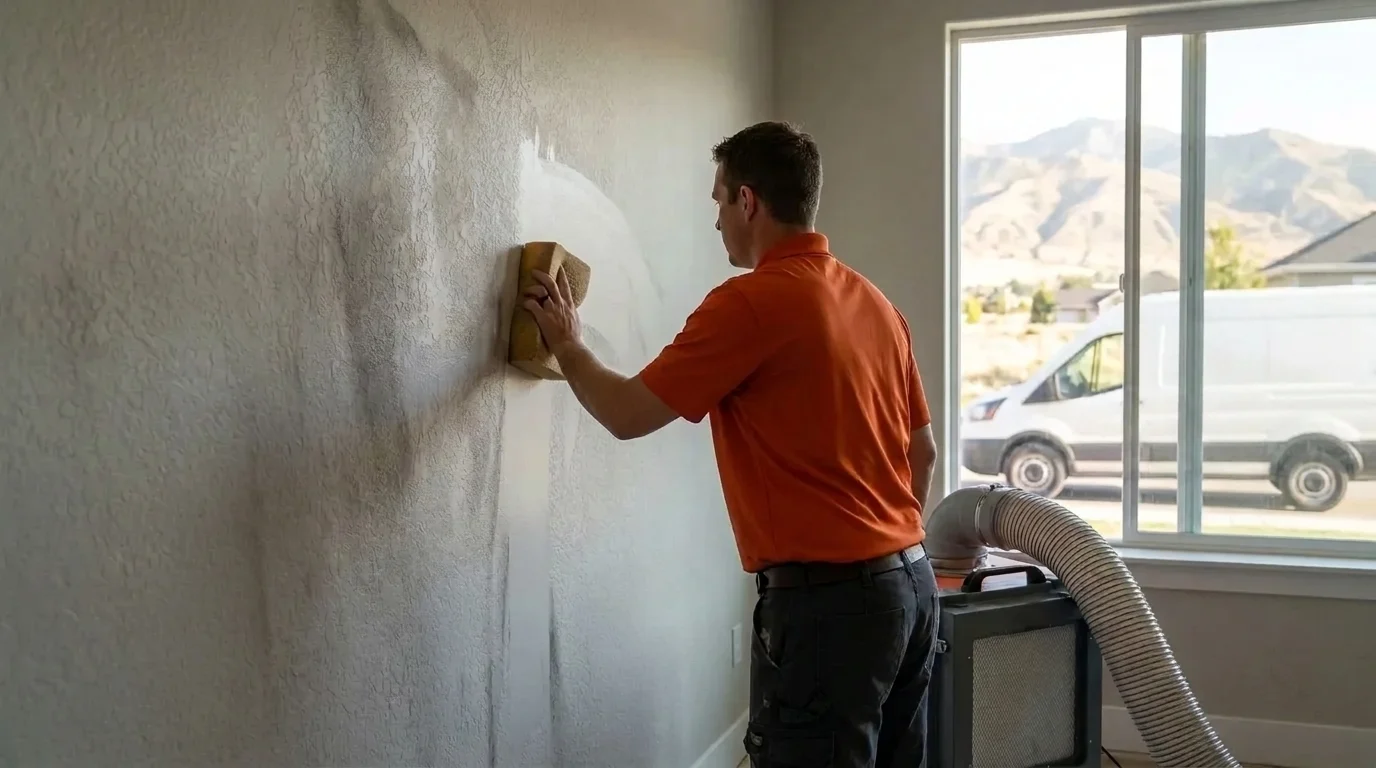
- Surface cleaning and residue removal. Walls, ceilings, cabinetry, and hard contents are cleaned with soot sponges, HEPA vacuuming, and chemical sponges matched to the residue type, working from least to most aggressive to avoid smearing soot deeper into porous materials.
- Thermal fogging or ozone treatment. For odor that has penetrated carpet pad, wall cavities, or HVAC ducting, we use thermal fogging or ozone treatment to neutralize odor molecules at the same depth the smoke originally penetrated, rather than just masking the smell.
- Contents evaluation and pack-out. Furniture, electronics, and textiles are assessed on-site; items that can be restored are cleaned and deodorized, while items needing specialized treatment are packed out to our facility.
What separates a good smoke damage response from a bad one
The most common mistake is treating smoke damage repair as a surface cleaning job and stopping there. If the HVAC system ran during or after the fire, soot has almost certainly been pulled into the ductwork and will recirculate odor every time the system kicks on, even after the visible damage is gone. A thorough response always checks supply and return ducts, not just the room where the fire occurred.
Another frequent miss is masking odor instead of removing it. Air fresheners, scented sprays, and ozone used incorrectly can make a home smell fine for a week and then have the smoke odor return once humidity rises, because the underlying residue was never actually broken down. Insurance adjusters reviewing a claim will often ask whether ducts were inspected, whether thermal fogging or ozone treatment was documented, and whether contents were assessed room by room rather than written off in bulk. Clear before-and-after documentation and a written scope matter here just as much as the cleaning itself.
What does smoke damage restoration cost?
Costs vary widely based on how far the smoke traveled, the type of residue, and whether HVAC or structural cavities are involved. Every loss is different, which is why FIX Restoration provides a written scope of work before any cleaning begins. Homeowners insurance typically covers smoke damage restoration when it results from a covered fire event, including smoke that travels from a neighboring structure or a wildfire source.
| Scenario | Typical range |
|---|---|
| Single room, light protein soot | $500 - $1,500 |
| Multi-room smoke spread, synthetic soot | $2,000 - $6,000 |
| Whole-home smoke and odor with HVAC contamination | $6,000 - $15,000 |
| Wildfire smoke infiltration, attic and duct cleaning | $3,000 - $8,000 |
| Contents cleaning and deodorization (per room) | $400 - $1,200 |
Seasonal & regional considerations
Wildfire season along the Wasatch Front can push smoke indoors even when no fire occurs on the property itself, especially in homes with older attic ventilation or window seals that let fine ash particles settle into insulation. In winter, homes run HVAC systems more continuously, which means any residual smoke odor in ductwork gets recirculated more often and tends to feel worse during the coldest months than it did right after the fire.
Service area
FIX Restoration provides smoke damage restoration services from our American Fork base out to Lehi, Pleasant Grove, Orem, and the surrounding Utah County communities.
If smoke odor or soot residue is still lingering in your home, don’t wait for it to settle deeper into your walls and ductwork. Call (801) 930-9750 to begin smoke and soot removal and get a written scope before any work starts.
Services We Handle
- Soot Removal
Frequently Asked Questions
Does homeowners insurance cover smoke damage restoration?
What's the difference between protein soot and synthetic soot?
Can smoke odor come back after cleaning if the HVAC system wasn't treated?
How long does wildfire smoke cleanup take if there was no fire on my property?
Will thermal fogging or ozone treatment damage my belongings?
Looking for the best smoke damage restoration company in American Fork?
FIX Restoration provides smoke damage restoration in American Fork, UT and the surrounding area, and has served local property owners since 2012. Customers rate us 4.9 out of 5 stars across 558 Google reviews. We answer calls 24/7 — call (801) 930-9750 for immediate help.
Need Smoke Damage Restoration now?
We respond 24/7 across American Fork and surrounding UT cities.
Related Coverage
- Our Restoration Services
- Contact FIX Restoration
- Restoration Services in Alpine
- Restoration Services in Bluffdale
- Restoration Services in Cedar Fort
- Restoration Services in Cedar Hills
- Restoration Services in Cottonwood Heights
- Restoration Services in Draper
- Restoration Services in Eagle Mountain
- Restoration Services in Herriman
- Restoration Services in Highland
- Restoration Services in Lehi
- Restoration Services in Lindon
- Restoration Services in Orem
- The Fire Damage Restoration Process, Explained
- Emergency Smoke Damage Restoration in Herriman
- Emergency Smoke Damage Restoration in Springville
- Emergency Smoke Damage Restoration in Provo
- Fire & Smoke Restoration: What to Expect When You Call a Restoration Company